A Word From Our Sponsors…
- 3
Latest News
Being in the Know: The Latest Developments in Stem Cell Research
Jan. 16 2:27 p.m.
1 CommentsRead more
Valuable Offers
- 10 Amazing Functions of the Prostate Gland by BeWellBuzz
- WHY do you train? by Jaqui Karr
- Energy Wrap-Ups for 2011 - Enter 2012 by Kathy Roseborough
- What you should know about Gastric Bypass Surgery by Simon Lee
- Forbidden Healing by Capt. T. C. Randall
- Fiber drinks can help you lose weight by Simon Lee
- How To Immediately Reduce Your Toxic Exposures by HealingGrapevine
- 10 Best Fiber Foods: (BeWellBuzz) Did you know that fiber helps you los...
- Herbs for Panic Attacks: Some people suffer from sudden moments of fear and...
- Underrated Health Benefits of Chamomile Tea: Chamomile frequents the lips of herbalists and nat...
- 16 Health Benefits of Rosemary: Rosemary is a Mediterranean herb with needle-like ...
People Buzzin
Popular Posts
Eating for Your Blood Type: A+ & A-
All of us are individuals in our own right. Every individual's genetic make-up is unique, but at the...
33 CommentsRead more
Benefits of Turmeric for Skin and More
In India, you can't think about a curry without turmeric in it. However, it's only now that people a...
21 CommentsRead more
A Recipe for Healthy Eyes
Age-related macular degeneration affects the part of the eye responsible for central vision, leading...
32 CommentsRead more
Cold or Warm Water. What’s better?
Is drinking cold water good or bad for you? Does the temperature of the water matter at all? Believe...
26 CommentsRead more
10 Reasons Why Flu Shots Are More Dangerous Than a Flu!
The verdict is out on flu shots. Many medical experts now agree it is more important to protect your...
154 CommentsRead more
Mobile Buzz
Get BeWellBuzz updates on your iPhone, iPod or iPad! 
iPhone & iPod Touch App
Download BeWellBuzz for iPhone
1000+ Users
All About Antioxidants
Post date: Sept. 5, 2009 1:24 a.m.
What's Your Reaction? important funny typical scary outrageous amazing innovative finally

Antioxidants are found in Nature in compounds that are particularly rich in hydrogen and excess electrons. These hydrogen-rich and electron-rich compounds are usually visible to our eye as pigments of color in plants.
The richly pigmented plants prove to be the easiest way to discover and track down where real antioxidant values are to be found. Superfoods ranging from cacao to acai to goji berries to spirulina to blue-green algae to marine phytoplankton all contain extraordinarily-rich antioxidant content.
Antioxidants can be water or fat soluble. All raw, pure fats and oils are antioxidants as they contain excess electrons. That means, that not only are richly-colored foods loaded with antioxidants, but so are all raw olives, avocados, nuts, and seeds.
Antioxidants are known to stop runaway free radicals. Free radicals behave like bad drunks because they create problems in every cell they touch. Free radicals are aggressive oxygen molecules that oxidize and damage tissue. Free radical damage has been implicated in numerous symptoms ranging from skin wrinkles all the way to cancer.
According to the free radical theory, the more antioxidants you consume, the better, due to the ability of antioxidants to quench and deactivate free radicals.
Not only are antioxidants capable of quieting free radicals, some antioxidants have medicinal value. The xanthone antioxidants in the rind of the mangosteen fruit are known to fight the organisms that cause rheumatism and arthritis better than any other known botanical substance. The blue-pigment antioxidants in blue-green algae help increase the natural production of stem cells. For these reasons both of these antioxidants have been combined into a dynamic popular antioxidant formula we created called Blue Mangosteen.
Vitamins A, C, and E are considered antioxidants. Vitamin A is a metabolite of beta-carotene, a red pigment commonly found in plants (e.g. goji berries, carrots, etc.). Vitamin C is a well-known antioxidant with a tremendous volume of research behind it. We believe that natural vitamin C sources (Camu berry) instead of simply ascorbic acid are best. Vitamin E has undergone substantial revision in recent years as its antioxidant value varies with quality and type (tocotrienols or tocopherols). Tocotrienols are more powerful Vitamin E antioxidants than tocopherols.
Some atomic minerals, such as zinc and selenium, are considered antioxidants, but they are not capable of antioxidant action by themselves. These antioxidant minerals must work in conjunction with antioxidant enzymes in order to be effective.
The only known atom that acts independently as an antioxidant is hydrogen. Hydrogen neutralizes free radicals instantly (and completely) with no byproducts leftover except water. Dr. Flanagan’s MegaHydrate (a hydrogen supplement) has an ORAC score approximately ten times higher than any known food thus making MegaHydrate perhaps the world’s strongest antioxidant supplement.
The ORAC Score
The ORAC score is a scientific standard that determines which foods or substances have significant antioxidant values. The higher the ORAC score, the greater is the substance’s power as an antioxidant. ORAC scores increase as substances are reduced to powders because the surface area increases making the antioxidants more available. Rudolf Steiner believed, as did the great Vedic herbalists, that you could increase the value of an herb or food by properly drying and powdering it. No doubt, that they intuitively understood that by properly drying and powdering a substance you increase its antioxidant value making the substance even more effective.
If we look at the ORAC values of certain foods, we can begin to see the key antioxidant-rich foods. Of all major foods on the planet, cacao (raw chocolate) delivers the most antioxidants. Cacao (raw chocolate) is the richest antioxidant food in the world.
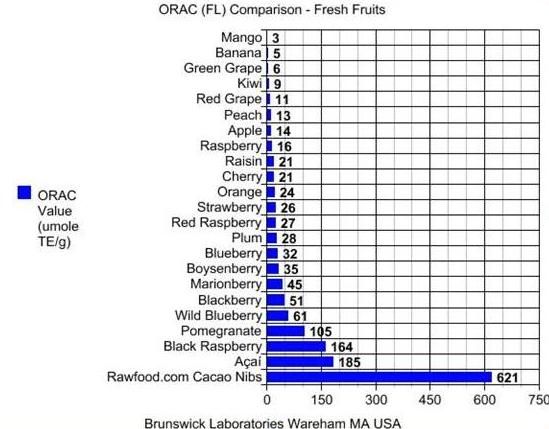
In 2007, a colleague and I took a trip to Hort Research in New Zealand. Hort is the preeminent antioxidant research facility in the world. There, the scientists explained to us that not only are the ORAC score important, what is perhaps even more valuable is how well the antioxidants present in the foods are absorbed into the blood stream. They told us that their evidence indicates that consuming cacao with berries may triple the absorption of the antioxidants (found in both foods) into the blood.
Antioxidant Blood Tests
Raw foodists and super foodists consistently score higher than the rest of the population in antioxidant blood tests. This evidence supports the ideas outlined within this article that richly pigmented foods such as raw fruits, vegetables, and superfoods (goji berries, cacao nibs, acai, camu berry, spirulina, blue-green algae, marine phytoplankton, etc.) as well as raw fats and oils (nuts, seeds, olive oil, flax seed oil, hempseed oil, etc.) are all powerful antioxidants.
To be clear, based on the evidence supplied by Hort Research, superfoods like cacao and goji berries or cacao and acai or cacao and camu berry when combined in smoothies or snacks create a synergistic effect thus increasing the utilization of the antioxidants. This is one more piece of evidence indicating that the habit of combining unique superfood ingredients in smoothies or snacks is being increasingly validated by science.
Cacao powder
Cacao nibs
Cacao butter
Sacred Heart Chocolate
Blue Mangosteen (medicinal antioxidants)
Tocotrienols (The Best Vitamin E Ever)
Acai
Spirulina
Blue-Green Algae
Marine Phytoplankton
Camu Berry powder
Pure Radiance C
Bee Pollen (extraordinary content of natural electrons)
Related posts

Telomeres and Aging
Telomeres play a central role in cell fate and aging by adjusting the cellular response to stress and growth stimulation. Inside the center or nu
6 CommentsRead more

Pycnogenol
What Is Pycnogenol?Pycnogenol is a natural plant extract with a copious amount of beneficial uses, as well as having the potential, with further s
2 CommentsRead more

Podcast 9 - Top 5 Superfoods You Can't Live Without
Todays podcast is about the most amazing and powerful superfoods on the planet. These foods are healing and rich in nutrients and should be a staple i
1 CommentsRead more


marijana
January 14, 2009 at 5:25 am
what a great news for us, chocolate lovers!!!
Like or Dislike:
0
0
Link
Pamela
January 27, 2009 at 4:54 am
What a great, clear explanation!
A fine, but important point: David, When an antioxidant food donates its spare electron to a free radical, does the food which donated the electron BECOME a free radical, since then IT has an unpaired electron?
Similarly: Does atomic hydrogen then BECOME a free radical when it donates an electron?
Are the electrons from the earth the only ones which do not become free radicals themselves?
It is because i respect you that i ask you difficult questions.
Happiness, Health and Abundance for All!
Like or Dislike:
0
0
Link
Kris Acai Berry Pills
March 24, 2009 at 5:16 am
thanks alot for this great post. So much details in the post i love it
Like or Dislike:
0
0
Link
TreeHuggers
August 4, 2010 at 12:13 am
Anti-oxidants have recently become a buzzword in nutrition and cancer circles. There are a lot of news stories and nutritional supplement advertisements touting anti-oxidants as “magic bullets” that will prevent the occurrence and/or spread of oral and other kinds of cancer. In truth, of course, there is no “magic bullet” to prevent cancer — but there IS a growing body of research that shows that anti-oxidants actually provide a kind of defense against this disease. To understand how, it is important to first examine another set of compounds known as free radicals.
The human body is made up of many different types of cells, which in turn are composed of different types of molecules. Molecules consist of atoms joined by chemical bonds, formed by the electrons in an atom’s outer shell. Normally, these bonds maintain stability; if they do split, they do so in balanced reactions. When weak bonds split, however, they may do so unevenly, creating what scientists call free radicals, or loose, unbalanced atoms or molecules. Often, these free radicals come from oxygen atoms; thus the term “oxidation” – not too dissimilar from the same process that causes metal to rust or apple pulp to turn brown.
Free radicals are very unstable compounds, without the proper number of electrons, and they tend to react quickly with neighboring compounds, trying to “steal” electrons from other molecules in an attempt to regain stability. If they succeed, then the “victim” atom or molecule usually loses its electron balance and becomes a free radical itself. In fact, even if the free radical is not able to steal the electron, it may still create such a pull as to disrupt the workings of neighboring atoms and molecules. This can start a chain reaction; and once the process is started, it can build exponentially.
Regarding cancer, the chief danger comes from the damage free radicals cause when they react with important cellular components such as DNA or the cell membrane. The DNA is, in essence, the reproductive map of the cell; if it changes, even slightly, the cell may duplicate the change when it reproduces. These changes are known as “mutations” and they also start a chain reaction of sorts, leading to the development of mutated, cancerous tissue such as tumors and lesions.
Even with their potential for damage, the presence of a limited number of free radicals in the body is not necessarily dangerous; free radicals are actually part of the normal metabolism of a healthy body. In fact, sometimes the body’s immune system’s cells create free radicals deliberately in order to neutralize viruses and bacteria. An excess of free radicals can be dangerous, however. There are a number of substances which seem to stimulate the production of free radicals — pollution, radiation, tobacco, pesticides, and ultraviolet rays are some of the most common. Often, when something is purported to “cause cancer”, what it really causes is the creation of an excessive number of free radicals. Aside from cancer, free radicals have been linked to heart disease, aging, cataracts and impairment of the immune system. Researchers have also noted that free radical damage accumulates with age. Because it is not possible to directly measure free radicals in the body, scientists have reached these conclusions by measuring the by-products that result from free radical reactions.
So where do anti-oxidants come in? Anti-oxidants fight free radicals. As a cancer preventative, anti-oxidants appear to neutralize free radicals by donating one of their own electrons, thus making a free radical compound stable and ending the electron-”stealing” chain-reaction so dangerous to cells and DNA. The anti-oxidant compounds are able to do this because they themselves don’t become free radicals in the process — they appear to be stable with or without their donated electrons.
Our bodies naturally contain certain anti-oxidant enzymes such as superoxide dismutase, but we can also get them from the foods we eat. The best known anti-oxidants are beta carotene, vitamins C and E, and the mineral selenium. Other anti-oxidants include ginkgo biloba, coenzyme Q10, tocotrienols, and polyphenols, which are substances found in most plants.
It is important to note, however, that all anti-oxidants do not do the same job or work in the same manner. For example, copper, manganese, zinc, selenium and other trace minerals are really only anti-oxidants when they combine with bodily enzymes to try to eliminate free radicals. Vitamins A, C, E and beta-carotene seem to work on their own or in conjunction with each other. Vitamin C, for instance can work in partnership with vitamin E, cleaning free radical substances from vitamin E molecules so those molecules can continue to attack other free radicals. Beta-carotene converts to vitamin A, a powerful anti-oxidant, when there is a shortage of vitamin A in the body. Lycopene, found in many fruits and vegetables, appears to assist the male prostate, although it also has a positive anti-oxidant effect body wide as well.
As you can see, all anti-oxidants are not created equal. If you get an adequate supply of one anti-oxidant, it doesn’t mean you wouldn’t benefit by the use of another. There is also such a thing as too much of an anti-oxidant; Vitamin A can be toxic when taken in too large a quantity. This is an area where your own research should be combined with a consultation with a doctor or dietician.
No, anti-oxidants are not “magic bullets” – but they are tools, at least in a nutritional sense. As we continue to grow in our understanding of what causes cancer and what prevents it, anti-oxidants may turn out to be an extremely valuable tool.
NOTE: I’ve dedicated my life to Educating Consumers on Natural, Organic, Supplements, Vitamins, Healthy Living, Natural Healing, Non-Genetically Modified, Non-Chemical Enhanced or anything we consume made from Un-Natural Sources. I’m asking anyone who reads my articles to post articles like it, or my articles on Great Blogs like this one to spread the word and help make people healthier. You can take credit for the articles, you can go to my Facebook Fan page and get information from there if you’d like or you can go to my store by clicking on my name above for information. I don’t mind if you use articles from my websites. The more we work together, the bigger the demand will be to grow more Natural and Organic Foods. We can’t beat big business and stop them from producing products that cause a vast majority of America’s Health problems because they’re after quanity and profits. Until they see the market shift and start losing money, they won’t change. That’s up to us and it’s time we demand better, safer, healthier supplements, vitamins, and food. We can show them, we the consumers are in control. That all starts with education and helping educate people who have not yet learned about these subjects. My Facebook Fan page is located at http:/www.Facebook.com/TreeHuggersOnline
Thanks and I’ll post new articles like this once per week!
Like or Dislike:
0
0
Link
Roberto
September 16, 2010 at 12:50 pm
Can anyone tell me about the latest & greatest all new
super antioxidant food called maqui berry? I just saw
on the self of a health food store and the ORAC rating
is off the charts. It’s not listed here so I’ll throw
it out to the community.
Like or Dislike:
0
0
Link
Kitchen Rugs
October 11, 2010 at 9:30 am
free radicals are the number stuff that causes aging and kills our body slowly but surely
Like or Dislike:
0
0
Link