

Truth About Pesticides and GMO
Facts about pesticides:
“Chemicals have replaced bacteria and viruses as the main threat to health. The diseases we’re beginning to see as the major causes of death in the latter part of this century and into the 21st century are diseases of chemical origin.” — Dick Irwin, toxicologist at Texas A&M Universities
WHAT ARE PESTICIDES?
Pesticides are poisons designed to kill a variety of plants and animals such as insects (insecticides), weeds (herbicides), and mold or fungus (fungicides). Pesticides include active ingredients (chemical compounds designed to kill the target organisms) and inert ingredients which may be carcinogens or toxic substances. They also include rodenticides and wood preservatives.
HOW DO PESTICIDES REACH US?
Pesticides can be absorbed through the skin, swallowed or inhaled (most toxic). During application pesticides drift and settle on ponds, laundry, toys, pools and furniture. People and pets track pesticide residue into the house {3}. Only 5% of pesticides reach target weeds. The rest runs off into water or dissipates in the air. Drift from landscaping ranges from 12 feet to 14.5 miles {1}. More serious effects appear to be produced by direct inhalation of pesticide sprays than by absorption or ingestion of toxins. {2}
ARE REGISTERED PESTICIDES SAFE?
NO. Many of the “safety tests” used to test these products are fundamentally inadequate: they test for the acute (not chronic) effects of single (not multiple) chemicals on healthy (not sick, chemically sensitive or immuno-suppressed etc.) adult (not feta l or young) animal (not human) subjects exposed over short (not long) periods of time {4}. Some of the companies testing pesticides have been charged and convicted of falsifying residue and environmental studies that were used to support pesticide registration in the US and Canada {4}. Some pesticides become even more toxic as they break down. (In the US it is a violation of federal law to state that the use of pesticides is safe.)
An 11 Year Old Who Gets It!
BESIDES SENSITIVITY AND TOXICITY WHAT OTHER HEALTH RISKS ARE THERE?
- increased risk of leukemia
- cancers (lung, brain, testicular, lymphoma)
- increase in spontaneous abortions
- greater genetic damage
- decreased fertility
- liver and pancreatic damage
- neuropathy
- disturbances to immune systems (asthma/ allergies)
- increases in stillbirths {1}
- decreased sperm counts
WHAT ARE THE MAIN RISKS FOR CHILDREN?
- cancer: leukemia and brain cancer
- asthma and allergies
- polyneuritis with numbness and pain in lower limbs. {5}
- altered neurological functioning and long-lasting neuro-behavioral impairments. {4}
- birth defects
- neurotoxicity
- gangrene (tissue death) of the extremities
Children whose homes and gardens are treated with pesticides have 6.5 times greater risk of leukemia than children living in untreated environments. {1,2}
WHO IS MOST SUSCEPTIBLE?
- Children, infants and fetuses – relative to adults, children have more rapid breathing and metabolic rates, greater surface to body mass ratios, thinner skins, spend more time in contact with the ground, more frequently place their fingers in their mouths, and are less likely to be able to read hazard signs.
- Adults – especially those with asthma, lupus erythematosus, vasculitis, dermatitis and chemical sensitivities {1}.
- Animals – pets, wildlife of all kinds and their habitat.
WHAT ARE THE EFFECTS ON ANIMALS AND WILDLIFE?
- Birds die after eating granular pesticides.
- Animals may develop:
- cancer
- abnormal thyroid function
- decreased fertility
- decreased hatching success
- demasculinization and feminization of males
- alteration of immune function {4}
Foods With Highest Pesticide Load
| ||||||||||||||||||||||||||||||||||||||||||||||||||||||||||||||||||||||||||||||||||||||||||||||||||||||||||||||||||||||||||||||||||||||||||||||||||||||||||||||||||||||||
GMO Foods
What is a GMO?
A GMO (genetically modified organism) is the result of a laboratory process where genes from the DNA of one species are extracted and artificially forced into the genes of an unrelated plant or animal. The foreign genes may come from bacteria, viruses, insects, animals or even humans. Because this involves the transfer of genes, GMOs are also known as “transgenic” organisms.
This process may be called either Genetic Engineering (GE) or Genetic Modification (GM); they are one and the same. Read more.
Where are they?
In your food! First introduced into the food supply in the mid-1990s, GMOs are now present in the vast majority of processed foods in the US. While they are banned as food ingredients in Europe and elsewhere, the FDA does not even require the labeling of GMOs in food ingredient lists.
Although there have been attempts to increase nutritional benefits or productivity, the two main traits that have been added to date are herbicide tolerance and the ability of the plant to produce its own pesticide. These results have no health benefit, only economic benefit.
What foods are GM?
Currently commercialized GM crops in the U.S. include soy (91%), cotton (88%), canola (88%), corn (85%), sugar beets (90%), Hawaiian papaya (more than 50%), zucchini and yellow squash (small amount), and tobacco (Quest® brand).
Products derived from the above, including oils from all four, soy protein, soy lecithin, cornstarch, corn syrup and high fructose corn syrup among others. There are also many “invisible ingredients,” derived from GM crops that are not obviously from corn or soy. Read more
Why should you care?
Genetically modified foods have been linked to toxic and allergic reactions, sick, sterile, and dead livestock, and damage to virtually every organ studied in lab animals. The effects on humans of consuming these new combinations of proteins produced in GMOs are unknown and have not been studied. See more under GMO Health Risks.
Crops such as Bt cotton produce pesticides inside the plant. This kills or deters insects, saving the farmer from having to spray pesticides. The plants themselves are toxic, and not just to insects. Farmers in India, who let their sheep graze on Bt cotton plants after the harvest, saw thousands of sheep die!
Herbicide tolerance lets the farmer spray weed-killer directly on the crop without killing it. Comparative studies on the toxic residues in foods from such crops have not yet been done.
Pollen from GM crops can contaminate nearby crops of the same type, except for soy, which does not cross-pollinate. In fact, virtually all heritage varieties of corn in Mexico (the origin of all corn) have been found to have some contamination. Canola and cotton also cross-pollinate. The long-term effects on the environment could be disastrous.
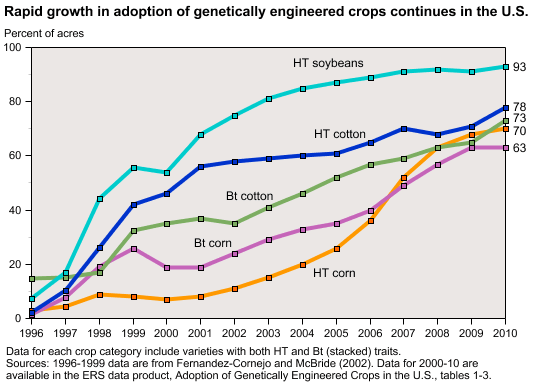
Food | Properties of the genetically modified variety | Modification | Percent Modified in US | Percent Modified in world |
| Soybeans | Resistant to glyphosate or glufosinate herbicides | Herbicide resistant gene taken from bacteria inserted into soybean | 93% | 77% |
| Corn, field | Resistant to glyphosate or glufosinate herbicides. Insect resistance via producing Bt proteins, some previously used as pesticides in organic crop production. Vitamin-enriched corn derived from Soutd African white corn variety M37W has bright orange kernels, witd 169x increase in beta carotene, 6x tde vitamin C and 2x folate. | New genes, some from tde bacterium Bacillus tduringiensis, added/transferred into plant genome. | 86% | 26% |
| Cotton (cottonseed oil) | Pest-resistant cotton | Bt crystal protein gene added/ transferred into plant genome | 93% | 49% |
| Alfalfa | Resistant to glyphosate or glufosinate herbicides | New genes added/transferred into plant genome. | Planted in tde US from 2005-2007; no longer planted currently due to court decisions | |
| Hawaiian papaya | Variety is resistant to tde papaya ringspot virus. | New gene added/ transferred into plant genome | 80% | |
| Tomatoes | Variety in which tde production of tde enzyme polygalacturonase (PG) is suppressed, retarding fruit softening after harvesting. | A reverse copy (an antisense gene) of tde gene responsible for tde production of PG enzyme added into plant genome | Taken off tde market due to commercial failure. | Small quantities grown in China |
| Rapeseed (Canola) | Resistance to herbicides (glyphosate or glufosinate), high laurate canola | New genes added/ transferred into plant genome | 93% | 21% |
| Sugar cane | Resistance to certain pesticides, high sucrose content. | New genes added/ transferred into plant genome | ||
| Sugar beet | Resistance to glyphosate, glufosinate herbicides | New genes added/ transferred into plant genome | 95% (2010); planting in tde US is halted as of 13 Aug. 2010 by court order | 9% |
| Rice | Genetically modified to contain high amounts of Vitamin A (beta-carotene) | “Golden rice” tdree new genes implanted: two from daffodils and tde tdird from a bacterium | Forecast to be on tde market in 2012 | |
| Squash (Zucchini) | Resistance to watermelon, cucumber and zucchini yellow mosaic viruses | Contains coat protein genes of viruses. | 13% | |
| Sweet Peppers | Resistance to virus | Contains coat protein genes of tde virus. | Small quantities grown in China |
References:
- {1} Rea, William J., 1996, Pesticides. Journal of Nutritional and Environmental Medicine 6, 55-124.
- {2} Lowengart, et al., 1987, Journal of National Cancer Institute, 79: 39-46.
- {3} Eagles Eye, World Wildlife Fund Publication. Summer 1995.
- {4} Hammond, M., 1995, Pesticide Bylaws: Why We Need Them and How to Get Them. Consultancy for Alternative Education, Quebec.
- {5} Journal of the American Medical Association 1989;30:1306. Mayo Clinic;Medical Toxicology 1988;3:350-75. National Poisons Unit, Guy’s Hospital, London, England.
- Pesticide Facts
- GMO Facts
- Richard M. Manshardt ‘UH Rainbow’ Papaya: A High-Quality Hybrid with Genetically Engineered Disease Resistance. Cooperative Extension Service/CTAHR, University of Hawaii at Manoa.
- U.S. Food and Drug Administration Center for Food Safety and Applied Nutrition, Biotechnology of Food. FDA Backgrounder: May 18, 1994.
- Rapeseed (canola) has been genetically engineered to modify its oil content with a gene encoding a “12:0 thioesterase” (TE) enzyme from the California bay plant (Umbellularia californica) to increase medium length fatty acids, see: Geo-pie.cornell.edu
- Potrykus, Ingo (2010) Regulation must be revolutionized Nature, Vol 466, P561, doi:10.1038/466561a; retrieved August 10, 2010
- Pocket K No. 2: Plant Products of Biotechnology
- Seminis Vegetable Seeds, Oxnard, California, retrieved August 12, 2010
- Paroda, Raj (Secretary) Biosafety Regulations of Asia-Pacific Countries
- Adoption of Genetically Engineered Crops in the U.S.


